












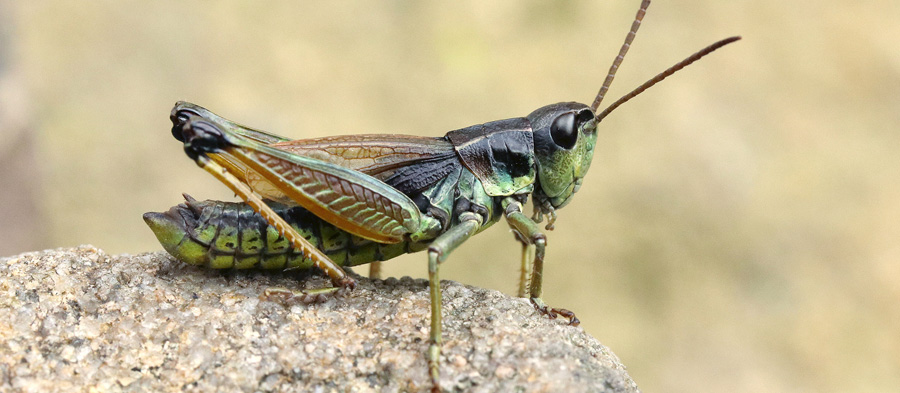
Czech scientists discover a new grasshopper species in the Tatra Mountains
A single blurry photograph led Czech scientists to a new species of grasshopper. The team, which included Petr Kočárek from the Faculty of Science at the University of Ostrava, discovered the species in the upper reaches of Žiarska dolina in Slovakia’s Western Tatras.
The discovery began on iNaturalist, a platform where people can upload photographs of plants and animals. One image caught the eye of Robert Vlk of the Regional Museum in Mikulov. He noticed that the grasshopper resembled members of the genus Podismopsis. The discovery illustrates how citizen science can contribute to research.
“It came as quite a surprise because this genus had never been recorded in the Western Tatras. The nearest known record was in the Austrian Alps, about 450 kilometres away. That blurry photograph ended up bringing together researchers from several institutions. On a joint expedition to Žiarska dolina, we confirmed that grasshoppers of this genus do live there. When we compared them in detail with related species, we realised we had found a species that had never been described,” says Robert Vlk.
Joining Robert Vlk in the study were Pavel Marhoul of Beleco, Petr Kočárek of the Faculty of Science at the University of Ostrava, and Jaroslav Holuša of the Czech University of Life Sciences Prague.
“When we returned from the Tatras, we needed specimens of related species to see whether the features we had observed in the Tatra grasshoppers fell within the normal range of variation for a known species. We borrowed specimens of a closely related Alpine species from a museum in St Gallen, Switzerland, and specimens of two other species from the National Museum in Prague. This allowed us to compare the grasshoppers side by side and confirm differences in physical features that we couldn’t see in the photograph,” explains study co-author Jaroslav Holuša of the Czech University of Life Sciences Prague.
The researchers named the new species Podismopsis kristini in honour of Slovak entomologist Anton Krištín. The grasshopper is about 1.5 to 2 centimetres long and lives in cold, windswept mountain grasslands at elevations of 1,820 to 1,920 metres. So far, it is known only from an area of about 1.5 square kilometres. Its resemblance to other mountain grasshoppers may help explain why it went unnoticed for so long.
“We examined the grasshoppers’ physical features, compared their DNA and analysed the males’ songs. The differences between closely related European species are subtle. They include the shape of the shortened wings and the pattern of veins in them, the length of the antennae and the structure of the male genitalia. The songs, however, are very similar,” says Petr Kočárek of the Faculty of Science at the University of Ostrava.
The discovery also sheds light on Europe’s natural history. Four other mountain species of the same genus live in central and southern Europe, each confined to a small area in the Alps, the Carpathians or the Dinaric Alps. DNA comparisons suggest that the Tatra grasshopper and its Alpine relative, Podismopsis keisti, began to diverge between 200,000 and 300,000 years ago. In evolutionary terms, this is a relatively recent split, which helps explain why the two species look so alike.
“During the ice ages, their ancestors probably occupied a much more continuous range across the cold steppes. As the climate warmed, they retreated to higher elevations until individual populations were isolated on mountain ‘islands’ of suitable habitat. Since these grasshoppers cannot fly, the warmer lowlands between mountain ranges are an almost impassable barrier for them. This isolation created the conditions for distinct species to evolve,” concludes Pavel Marhoul of Beleco.
The study was published in the scientific journal ZooKeys.
Photos and videos by Associate Professor Petr Kočárek
Updated: 27. 11. 2026

